
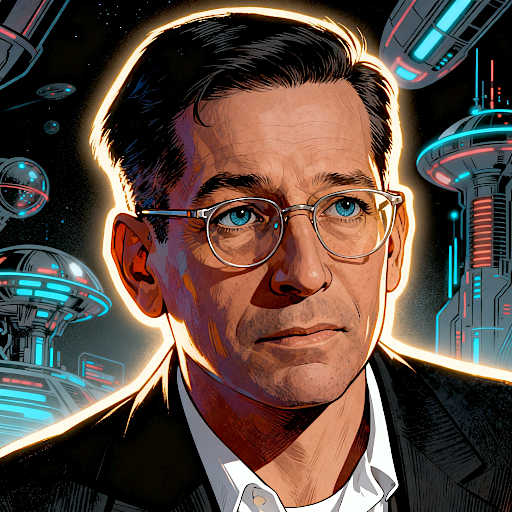
In an era of science fiction defined by the roar of rocket engines and the cold calculations of hard physics, Edgar Pangborn offered something far more radical: tenderness. While his contemporaries were busy mapping the mechanics of galactic empires, Pangborn was looking inward, exploring the quiet, often fragile spaces where technology meets the human spirit.
Born in New York City in 1909 to a family of literary creators, Pangborn’s path to science fiction was anything but linear. A child prodigy who entered Harvard to study music at just fifteen, his life was a tapestry of diverse experiences; from the rhythms of classical composition to the disciplined service of the U.S. Army Medical Corps during World War II. It was this unique breadth of experience, the precision of a musician and the empathy of a medic, that would eventually define his prose.
Pangborn did not arrive on the science fiction scene until 1951, but when he did, he arrived with a fully formed, deeply compassionate vision. His debut, “Angel’s Egg,” published in Galaxy Science Fiction, bypassed the era’s obsession with gadgetry to focus on something much more profound: the ache of loneliness and the hope for connection. It was a signal to the genre that science fiction could be more than an adventure; it could be a mirror.
Throughout his career, Pangborn became a master of the “humanist” tradition. In award-winning works like A Mirror for Observers and the Hugo-nominated Davy, he eschewed the spectacle of destruction to focus on cultural anthropology and ethics. Whether he was writing about pastoral, post-apocalyptic landscapes in his “Darkening World” cycle or exploring the weight of moral responsibility, his focus remained steadfastly on how humanity survives—physically and emotionally. He excelled at creating “lived-in” futures where the true struggle wasn’t against alien invaders, but against the loss of our own empathy.
Though his bibliography is more intimate than the sprawling epics of his peers, his influence is monumental. You can hear his echoes in the sociological depth of Ursula K. Le Guin and the lyrical myth-making of Peter S. Beagle. He taught a generation of writers that the most important frontier isn’t the edge of the galaxy, but the boundaries of human compassion.
Edgar Pangborn passed away in 1976, leaving behind a legacy that refuses to fade. Posthumously honored with the Cordwainer Smith Rediscovery Award, he remains a “writer’s writer,” a master of the gentle precision that reminds us that even amid the ruins of civilization or the vastness of the void, our greatest strength lies in how we treat one another.