In the pantheon of science fiction’s founding architects, names like Wells and Verne shine with a bright, cinematic light. But in the quiet shadows of the late 19th century, another titan was building a different kind of universe: one constructed not just of gears and ray guns, but of ethics, empathy, and profound philosophical inquiry.
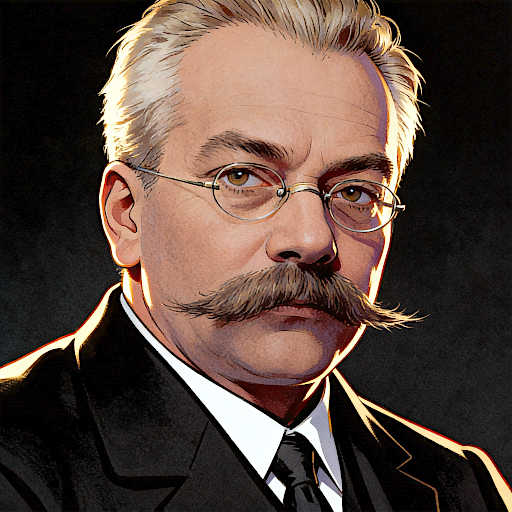
This was Carl Theodor Victor Kurd Laßwitz, born April 20, 1848, in Breslau (now Wrocław, Poland). A man of exquisite intellect, Laßwitz moved through the world with a rare duality, possessing the rigorous, unyielding precision of a mathematician and the whimsical, searching heart of a philosopher. His life was defined by a quiet, courageous friction with the world around him.
Though trained in the hard sciences of physics and mathematics, Laßwitz’s liberal, freethinking spirit made him an outsider in the rigid, conservative landscape of Imperial Prussia. Denied the university chair he craved due to his refusal to bow to political orthodoxy, he turned his gaze toward the classroom at the Gymnasium Ernestinum. There, as a beloved teacher, his wit and sharp-edged bons mots became legendary, leaving an indelible mark on a generation of students who learned from him that science and humanity are inseparable.
Often revered as the father of German science fiction, Laßwitz occupied a unique space in the intellectual landscape of his time. While his masterpiece, Auf zwei Planeten (On Two Planets, 1897), stands as a monumental feat of speculative world-building, it eschews the tropes of conquest. Instead, he imagined a breathtakingly peaceful encounter between Earth and an advanced Martian civilization: a diplomatic ballet that explored the heavy responsibilities of technological power, the ethics of cultural intervention, and the fragile beauty of democracy.
Laßwitz didn’t just predict the technology of our future, foreseeing solar energy, anti-gravity, and even synthetic nutrition; he interrogated the soul of that future. He asked: If we meet the “Other,” will we bring our prejudices, or our potential?
When he wasn’t exploring the far reaches of the solar system, he was crafting “modern fairy tales:” witty, satirical gems that revealed a man who found profound joy in the absurdities of the human condition. But Laßwitz’s writing carried a weight that made it dangerous. His deeply democratic and pacifist convictions were so potent that even after his death in 1910 they drew the ire of the Nazi regime, which banned his works for their refusal to succumb to nationalist fervor.
To read Laßwitz is to encounter a writer who believed that scientific progress is hollow without a corresponding evolution in human morality. His legacy is etched into the very fabric of the Space Age. The dreams he spun in the classrooms of Gotha provided the mathematical and imaginative scaffolding for the pioneers of rocketry, including Eugen Sänger and Wernher von Braun. He planted the seeds of a cosmic consciousness long before we had ever left our orbit.
Today, as we navigate an era defined by rapid technological upheaval and global uncertainty, Laßwitz’s voice is more vital than ever. He remains the essential guide for anyone who believes that science fiction should do more than just entertain; that it should challenge us to become a species worthy of the stars.