
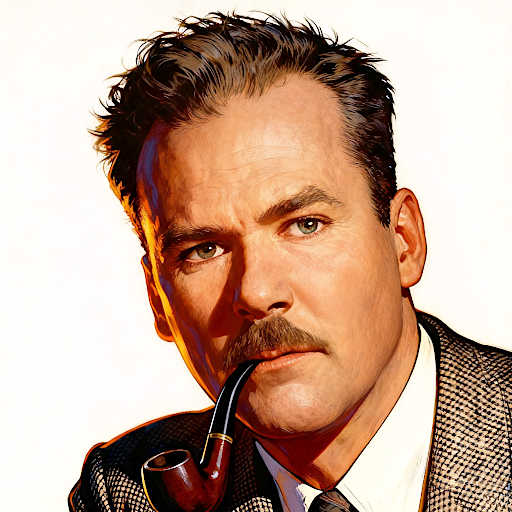
Before he was a master of speculative economics, Dallas McCord Reynolds was a child of political unrest. Born on November 11, 1917, in Corcoran, California, Reynolds entered a world defined by ideological friction. Raised by his father, the prominent socialist activist Verne La Rue Reynolds, Mack’s imagination was forged in the crucible of debate. While his contemporaries often looked to the stars for escape, Reynolds looked to the structures beneath our feet: the systems, the laws, and the ideologies that dictate how we live.
Reynolds’s perspective was not shaped by academic seclusion, but by the grit of lived experience. His service in the U.S. Army during World War II and his subsequent time living abroad in Mexico, North Africa, Europe, Japan, and Hong Kong, exposed him to a profound diversity of cultures and political realities. He carried this firsthand understanding of global friction into his prose, bringing a rare, palpable tension between political theory and human reality to the pages of the genre.
Emerging in the golden age of the 1950s, Reynolds became a vital voice in legendary magazines such as Astounding Science Fiction and Galaxy Science Fiction. While giants like Isaac Asimov were refining the logic of technological progress and Robert A. Heinlein was exploring the frontiers of individualism, Reynolds was doing something far more radical: he was conducting social experiments. His stories functioned less as predictions of gadgetry and more as rigorous inquiries into the extremes of capitalism, socialism, and the hybrid systems that follow.
He was rarely concerned with the gleaming hulls of starships or the intricate mechanics of future devices. Instead, Reynolds focused on the human cost of progress. Through recurring characters like Joe Mauser, he navigated shifting economic landscapes from the complexities of guaranteed income to the profound existential shifts of post-scarcity societies where traditional labor has vanished. Long before automation and universal basic income entered our modern political lexicon, Reynolds was already exploring their implications with a signature blend of curiosity and skepticism.
Though his prose lacked the overt lyricism of a Ray Bradbury, it possessed a formidable, functional sharpness. Every story was built with a clear, analytical purpose: to examine a premise and follow it to its logical, often unsettling, conclusion. Yet, beneath this intellectual surface lay a deeply moving human concern: the search for identity, dignity, and meaning in a world that might eventually render the individual economically unnecessary.
His bibliography stands as a testament to this intellectual rigor, from the reimagined utopias of Looking Backward, from the Year 2000 to the social consequences explored in Compounded Interests. Even when playing with narrative form—as seen in his collaboration with Fredric Brown on the darkly ironic Happy Ending—Reynolds remained anchored to his central mission.
A lifelong socialist, Reynolds approached the clash of ideologies not as a detached observer, but as an active participant in the debate. He was willing to interrogate even the ideas closest to his own heart, creating works that resist easy answers and celebrate the complexity of unintended consequences.
Though he may not have shared the same level of mainstream celebrity as some of his peers, Reynolds carved out a singular, essential space in science fiction: the bridge between pulp accessibility and serious socio-economic inquiry. His influence echoes through modern speculative fiction that grapples with automation and the fragility of our economic structures. In an era defined by these very anxieties, Reynolds’s work feels less like a historical artifact and more like an early map of a terrain we are only now beginning to traverse.
Mack Reynolds passed away on January 30, 1983, leaving behind a legacy that continues to provoke rather than comfort. He remains a writer of systems and souls alike: a quiet architect of the future, reminding us that our destiny is shaped not just by what we build, but by how we choose to live within it.